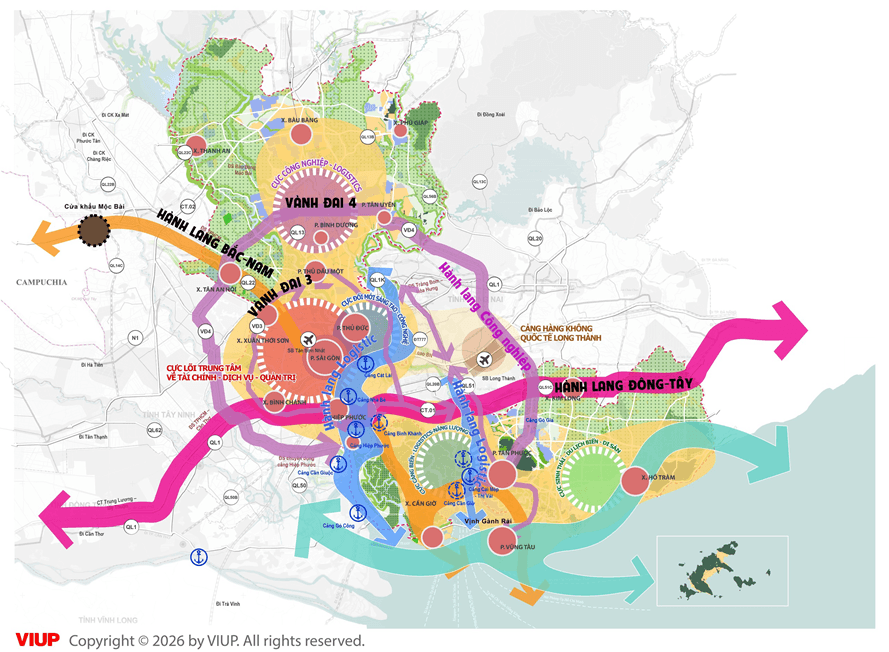
Ho Chi Minh City publicly unveiled its 100-year master plan developed by the National Urban and Rural Planning Institute in collaboration with BCG. For most observers, this is a long-term policy document. For foreign investors evaluating where to position capital over the next 10 to 20 years. The it is a map showing exactly which parts of the city the government is willing to bet on. So where to puts in HCMC long-term real estate investment?
Contents
On May 17, 2026, the HCMC People’s Committee officially approved the Master Plan Outline for the 2025-2050 period, with a 100-year vision. This marks the first time HCMC has an official long-term framework, serving as a legally binding document for HCMC long-term real estate investment instead of a discussion paper (VnEconomy, May 17, 2026).
Post-merger scale places HCMC in an entirely new position:
Development orientations specify that HCMC operates under a polycentric megacity model, no longer a unipolar city focused on the city center core but expanding into multiple linked growth poles. The backbone infrastructure consists of a network of metro, TOD, underground, and elevated spaces.
Among these, East HCMC sits at the intersection of at least three out of six specialized zones identified in the plan: the high-tech chip/semiconductor zone, the international financial center, and the commercial-cultural zone. The 100-year plan does not change tomorrow’s market, but it determines which assets will retain value after 20 years.
Many international investors misunderstand VIFC-HCMC, and this misunderstanding creates opportunities for those who can read the market correctly.
According to Mr. Michael Kokalari, Chief Economist of VinaCapital, most investors believe Vietnam is trying to compete directly with Dubai or Singapore. The reality is completely different. VIFC-HCMC is built to solve a specific problem: Vietnam needs to mobilize around 1,500 billion USD in investment capital in the coming years. This financial center serves as a channel to attract international capital into the economy, not like Hong Kong or Shanghai.
Regarding the operational model, VIFC-HCMC is where new financial mechanisms are tested before national replication. The 898-hectare area in Thu Thiem operates under a specialized legal framework, featuring sandboxes for fintech, digital assets, green finance, and carbon credit markets.
The most critical point for HCMC long-term real estate investment: during the first 5 years of operation, HCMC retains 100% of VIFC revenues to reinvest in infrastructure and financial human resources. As the financial ecosystem forms in Thu Thiem, demand for luxury real estate from foreign financial and tech experts will create a new, long-term, high-paying rental demand class.Thu Thiem is not built to compete with Asia; it is built to be a gateway for global capital into Vietnam. Thu Thiem is positioned as a location with a unique fintech sandbox unprecedented in the region.
While VIFC-HCMC builds its financial ecosystem, Thu Thiem’s physical infrastructure accelerates simultaneously. This synchronized development between infrastructure and finance is rare.
As of June 2026, four main roads in Thu Thiem New Urban Area resumed construction after a 12-year delay:
Upon completion, this road system will directly connect Thu Thiem to Mai Chi Tho, Hanoi Highway, and the HCMC – Long Thanh – Dau Giay Expressway (Lao Dong, June 24, 2026).
Positioned as Vietnam’s first TOD 5.0 hub, Thu Thiem Station will converge Metro Line 2, the Thu Thiem – Long Thanh light rail (20 minutes to the airport), the North-South high-speed railway, and Metro Line 1 connections. No other station in Vietnam shares this connection density.
According to JLL (January 2026), real estate within a 10-minute walk from metro stations grows by 8%/year, doubling the market average of 4%. In Thu Thiem, this growth is backed by both transport infrastructure and a financial ecosystem, making Thu Thiem one of the strongest cases for long-term property investment in the city (The Osuk – The Metropole)
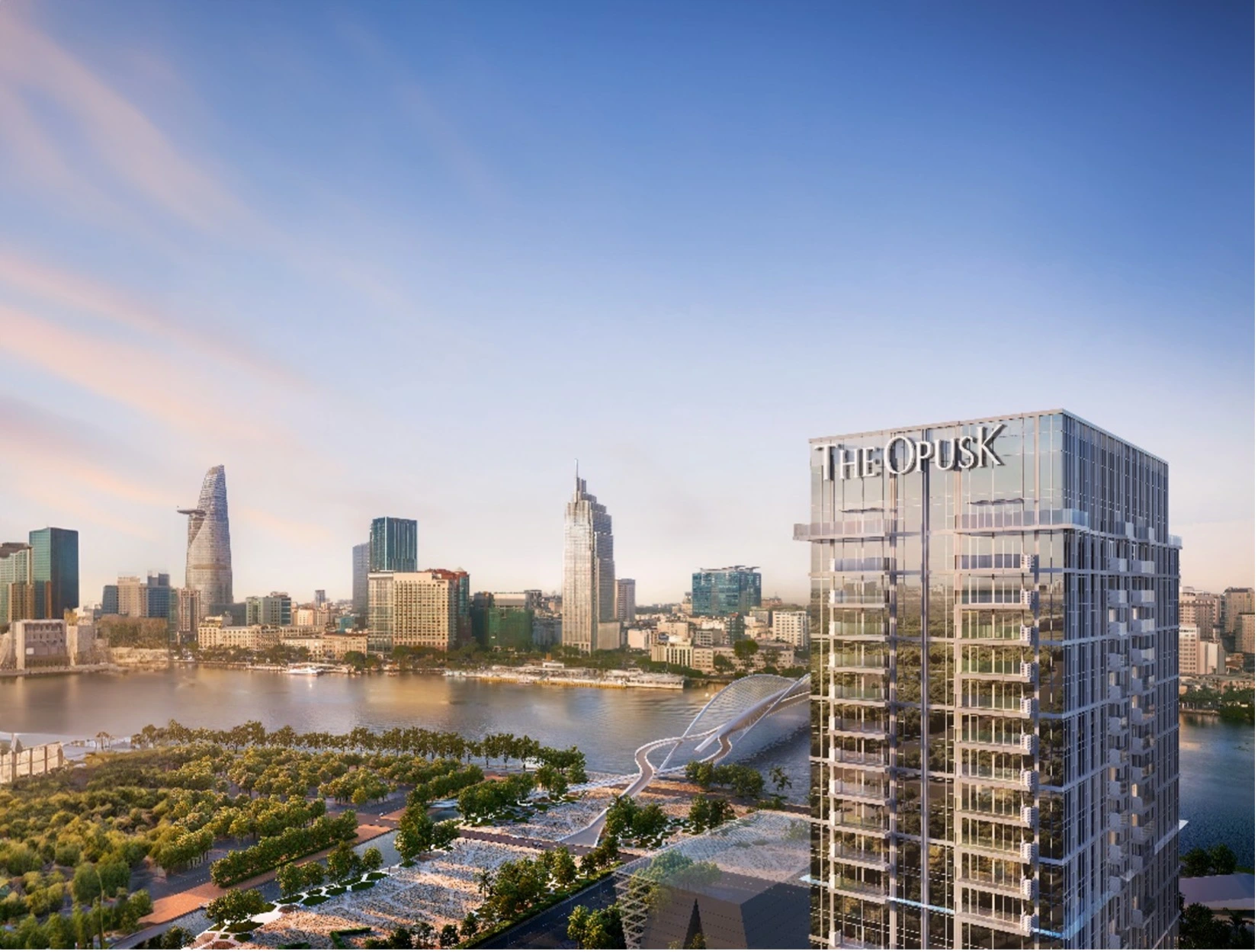
A 100-year plan does not guarantee outcomes; it reveals priorities. What the HCMC master plan makes clear is that East HCMC sits at the intersection of every major structural driver the city is building toward: an international financial center, a TOD 5.0 hub, a semiconductor and technology corridor, and a direct link to Long Thanh Airport. For foreign investors with a 10 to 20-year horizon, that kind of convergence does not happen twice in the same location.
Looking for a trustworthy real estate agent? La Quinta is your one-stop partner. We offer turnkey support for buying/selling, renting, interior design & furnishing, and full property management. Contact us today.
Mr. DONNIE KIM (Korean & English)
Associate Director
Phone number: 0898 48 38 68
Email: kdh@lqltd.com
Zalo: 0898 48 38 68 (La Quinta)
Kakaotalk ID : kdhrpm
WeChat: LQ-kdh
Whatsapp: +84 89 848 38 68
Ms. TRẦN HOÀNG OANH (Vietnamese & English)
Director of Residential and Investment Team
Phone number: (+84) 937 836 896
Email: christine@lqltd.com
Zalo: 09 3783 6896 (Oanh – Christine)
Whatsapp: +84 937 83 896
Wechat: Oanhhoangtran