On April 30, 2026, Dong Nai officially became Vietnam’s 7th centrally-run city, triggering a wave of real estate interest along the Long Thanh corridor. For foreign investors, the question is not whether this expansion creates opportunity it clearly does. The question is where to position it. Not all points along a corridor carry the same risk profile, liquidity, or income-generating capacity.
Contents
Vietnam’s urban map shifted on April 30, 2026, when the National Assembly’s resolution took effect, officially making Dong Nai the country’s 7th centrally-run city. With an area of 12,737 km² and a population of nearly 4.5 million, Dong Nai is now Vietnam’s largest city by land area and its elevation repositions the entire Southeast region’s development dynamic.
For foreign investors, this is not just an administrative change. It signals a structural expansion of the Greater Ho Chi Minh City urban zone along the Long Thanh corridor. Three infrastructure projects are accelerating this shift simultaneously:
When complete, An Phu Interchange will eliminate all cross-traffic conflicts at this critical node, where over 20,000 container trucks pass daily to Cat Lai Port. For Thao Dien and Thu Thiem located directly on this corridor, improved connectivity does not pull value away. It adds to it. Administrative borders are expanding. The anchor point of the East HCMC corridor remains exactly where it has always been.
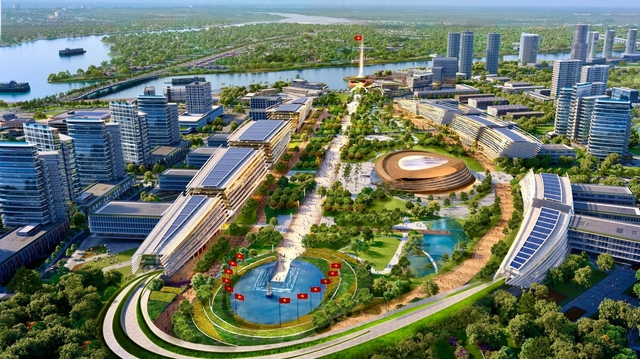
When Dong Nai officially became a city, real estate search interest in the province jumped 21% in the first nine months of 2025 twice the rate recorded in East HCMC during the same period (Batdongsan.com, 2025). On the surface, this looks like the capital away from Ho Chi Minh City. The reality is more nuanced.
According to Mr. Vo Hong Thang, Research Director at DKRA Consulting, achieving city status creates motivation to attract investment, develop infrastructure, and increase mechanical population growth. However, he notes that forming a complete urban ecosystem typically requires at least 5 to 10 years after the administrative upgrade takes effect.
This timeline matters for foreign investors with a 3 to 5 year investment horizon. Dong Nai’s transformation is structural and long-term. Yield, liquidity, and rental demand the three factors that determine short to mid-term return remain concentrated in established urban cores.
What the data actually shows is portfolio diversification, not migration. Institutional investors and high-net-worth individuals are allocating along the Long Thanh corridor as a whole, with East HCMC serving as the liquid, income-generating anchor while Dong Nai represents the longer-term appreciation play. Capital is not leaving HCMC. It is stretching along a corridor and the corridor starts in Thao Dien and Thu Thiem.
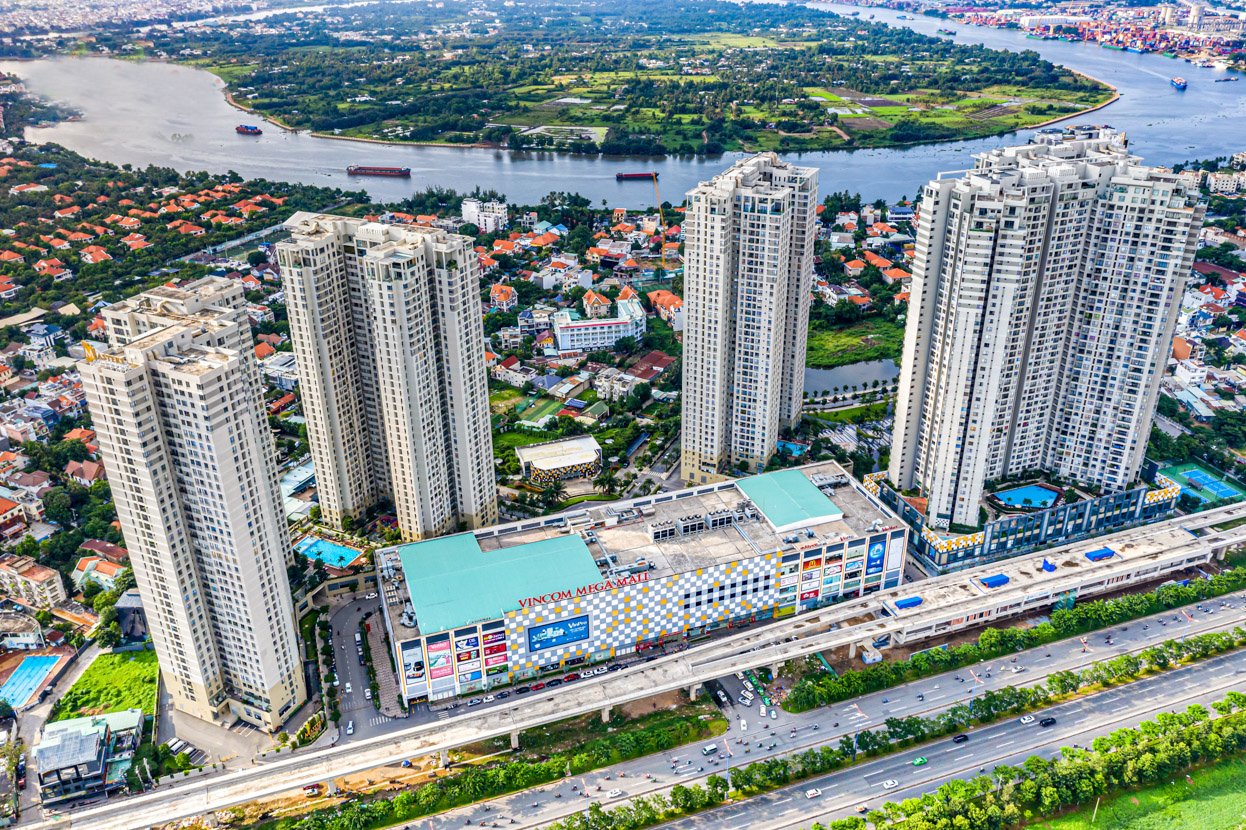
Along any urban corridor, there is always a core and a periphery. Infrastructure connects them but it does not make them equivalent. In the Long Thanh corridor, Thao Dien and Thu Thiem occupy the core position for three reasons that are measurable, not speculative.
The TOD zone around An Phu Station demonstrates what connectivity does to property values over time. Land prices in this area rose from 28–36 million VND/m² in 2014–2015 to 70–120 million VND/m² today, a 3 to 4 times increase over 10 years, driven directly by infrastructure milestones. According to JLL (01/ 2026), properties within a 10-minute walk of a metro station appreciated at 8%/year on average, double the market-wide rate of 4%.
Thu Thiem is not a single-driver market. Four structural catalysts are active at the same time: the Eco Smart City project resuming operations (targeted 2028), the new Administrative Center spanning 46.7 hectares under a Sun Group PPP, Metro Line 2 breaking ground on April 29th 2026, and the riverside park completing the district’s urban waterfront. Each catalyst reinforces the others and collectively they are creating structural scarcity in a market where primary supply is already limited.
Thao Dien hosts the largest expat community in Ho Chi Minh City, generating consistent long-term rental demand that is largely insulated from domestic market sentiment. Airbnb yield in this area runs at 5–7%/year, while long-term rental yield holds at 3–4% both figures remaining above the break-even threshold for investors using reasonable leverage at current interest rates. Thao Dien and Thu Thiem are not competing with the Long Thanh corridor. They are the starting point of it.
Dong Nai’s elevation to city status expands the investment map but it does not redistribute the fundamentals. Yield, liquidity, and stable rental demand remain concentrated in established urban cores. For foreign investors evaluating entry points along the Long Thanh corridor, Thao Dien and Thu Thiem offer something the periphery cannot yet provide: a track record, an active expat rental market, and infrastructure catalysts that are already delivering not still being planned.
Looking for a trustworthy real estate agent? La Quinta is your one-stop partner. We offer turnkey support for buying/selling, renting, interior design & furnishing, and full property management. Contact us today.

Mr. DONNIE KIM (Korean & English)
Associate Director
Phone number: 0898 48 38 68
Email: kdh@lqltd.com
Zalo: 0898 48 38 68 (La Quinta)
Kakaotalk ID : kdhrpm
WeChat: LQ-kdh
Whatsapp: +84 89 848 38 68

Ms. TRẦN HOÀNG OANH (Vietnamese & English)
Director of Residential and Investment Team
Phone number: (+84) 937 836 896
Email: christine@lqltd.com
Zalo: 09 3783 6896 (Oanh – Christine)
Whatsapp: +84 937 83 896
Wechat: Oanhhoangtran